Some users may experience temporary issues accessing parts of the site. Thanks for your patience.
- Office Hours Mon - Fri 9:00 am – 4:00 pm EST

This virtual course is accessible on computers, tablets, and smartphones.
When you purchase an individual live stream, you can watch the event live and access the recording for 30 days. This gives you the flexibility to watch at your convenience — whether you miss the live session or want to revisit it later. Watch on any device, anytime, from anywhere in the world.
As a member of All Access+ or the Season Pass, you’ll have ongoing access to the recording for as long as your membership is active.
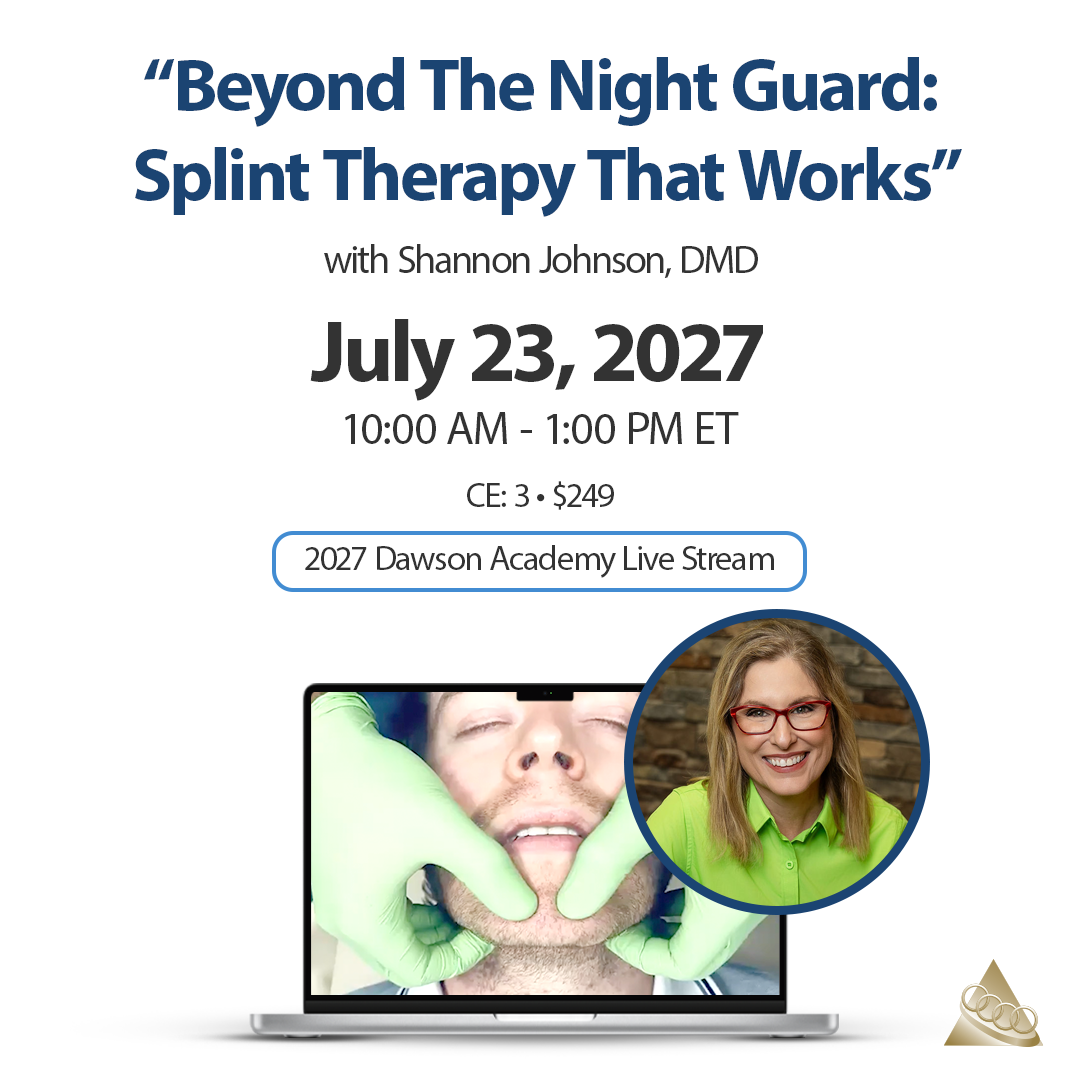
Occlusal splint therapy is one of the most misunderstood areas in restorative and TMD dentistry. Dentists are frequently confused by overlapping terminology (NTI, stabilization splint, deprogrammer, night guard), unclear indications for each appliance, and how splints fit into broader restorative planning. There are three recurring failure points: choosing an appliance designed for one problem (e.g., parafunction) to treat a different one (e.g., joint-based TMD), skipping the diagnostic step that differentiates muscle-based pain from intracapsular derangement, and moving into irreversible restorative treatment without first stabilizing occlusion using a splint.
This presentation addresses those gaps directly. It gives dentists a clear framework for selecting between full-coverage stabilization splints, anterior deprogrammers, and repositioning splints based on diagnosis rather than habit, shows how to use a deprogrammer diagnostically to separate muscle from joint pathology, and demonstrates how a diagnostic splint verifies a stable joint position before full-mouth rehab. It also covers common clinical pitfalls (fit, adjustment, tooth movement) and when to escalate rather than keep adjusting.
-Decode the naming chaos and learn to classify a splint by its function
-Match the splint to the problem — start with a diagnosis, then choose the splint design
-Apply a clear decision framework for choosing between splint choices based on case presentation, muscle vs. joint involvement, and patient risk factors.
-Use an anterior deprogrammer as a diagnostic tool to rapidly differentiate muscle-based TMD pain from intracapsular (joint) derangement.
-Recognize when NOT to use an anterior deprogrammer — including contraindications and situations where it can mask rather than resolve the underlying problem.
-Use a diagnostic splint to verify and transfer centric relation and vertical dimension of occlusion before committing to irreversible restorative or full-mouth rehab treatment.
-Avoid the top clinical pitfalls — poor impressions/fit, inadequate adjustment protocols, or unwanted tooth movement.
-Learn to appreciate when splint therapy is failing and how to escalate — recognizing signs a patient needs a different appliance, further diagnostics, or referral rather than more adjustments.
-Review how best to integrate splint therapy into a restorative treatment plan
Dr. Shannon Johnson
180 (1.5L) and 200 (1.5L)
Please contact The Dawson Academy at 1.800.952.2178 for full details.

The Dawson Academy is an ADA CERP Recognized Provider. ADA CERP is a service of the American Dental Association to assist dental professionals in identifying quality providers of continuing dental education. ADA CERP does not approve or endorse individual courses or instructors, nor does it imply acceptance of credit hours by boards of dentistry. The Dawson Academy designates this activity for 4 credit hours continuing education credits.
ADA CERP is a service of the American Dental Association to assist dental professionals in identifying quality providers of continuing dental education. ADA CERP does not approve or endorse individual courses or instructors, nor does it imply acceptance of credit hours by boards of dentistry.
Concerns or complaints about a CE provider may be directed to the provider or to the Commission for Continuing Education Provider Recognition at ADA.org/CERP.