Some users may experience temporary issues accessing parts of the site. Thanks for your patience.
- Office Hours Mon - Fri 9:00 am – 4:00 pm EST

This virtual course is accessible on computers, tablets, and smartphones.
When you purchase an individual live stream, you can watch the event live and access the recording for 30 days. This gives you the flexibility to watch at your convenience — whether you miss the live session or want to revisit it later. Watch on any device, anytime, from anywhere in the world.
As a member of All Access+ or the Season Pass, you’ll have ongoing access to the recording for as long as your membership is active.
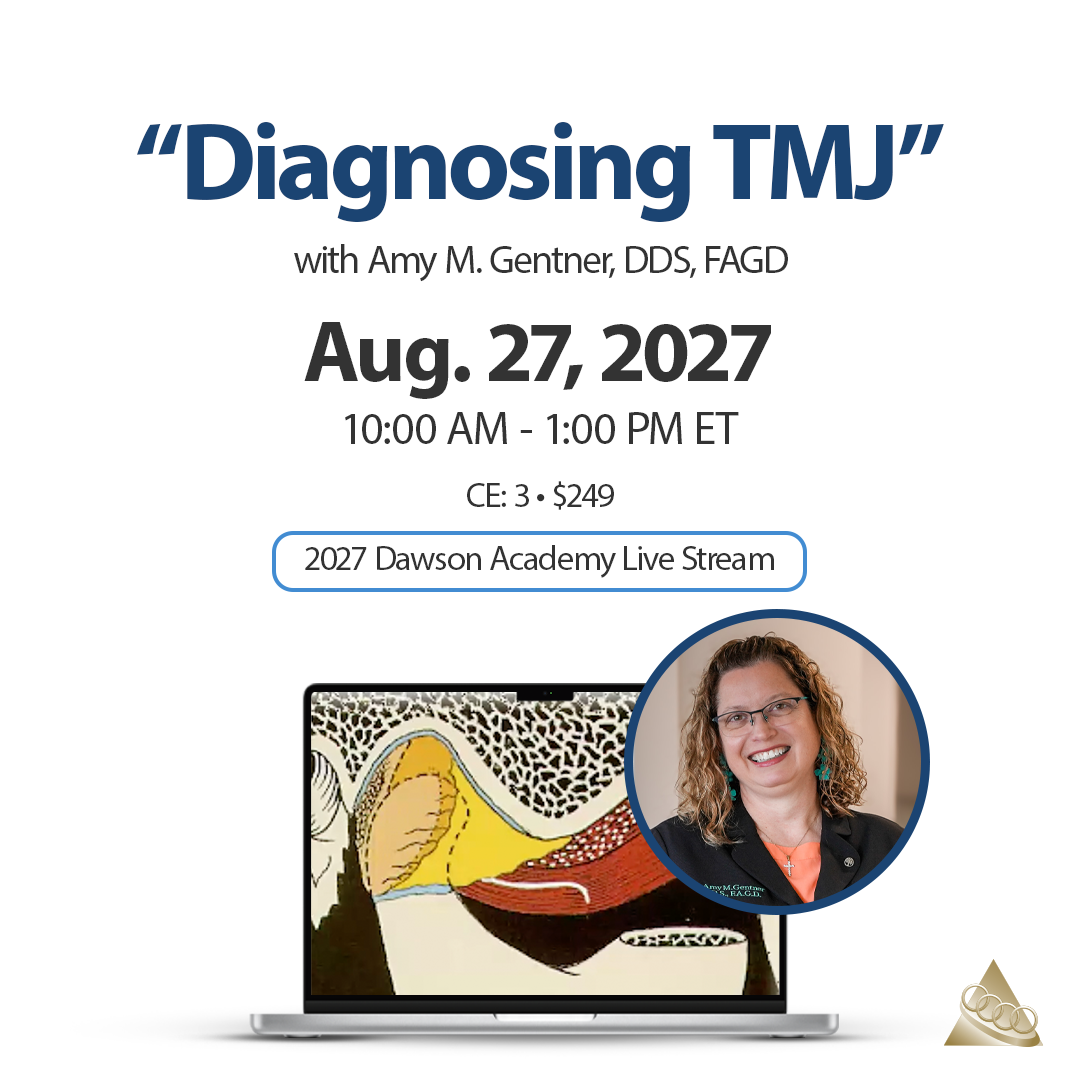
Before we change the teeth, we must understand the foundation they depend on. The temporomandibular joints influence occlusion, muscle comfort, mandibular movement, restorative predictability, orthodontic stability, implant planning, equilibration, and long-term success. Yet many joint problems are quiet, subtle, or hidden behind familiar findings such as wear, fractures, bite changes, muscle tension, headaches, or joint sounds.
This 3-hour course will guide dentists through a clearer, more organized approach to TMJ diagnosis in the restorative practice. The course will review healthy joint function, signs of instability, and the diagnostic information gathered through patient history, clinical examination, clinical testing, and imaging.
By connecting these findings into meaningful diagnostic categories, doctors will be better prepared to recognize when the joint foundation appears stable, unstable, or in need of further evaluation before definitive treatment begins.
At the completion of this course, participants will be able to:
-Explain why temporomandibular joint stability is essential before changing the teeth in restorative, orthodontic, implant, equilibration, and esthetic treatment.
-Describe the anatomy and function of a healthy TMJ, including the relationship between the condyle, disc, muscles, mandibular movement, and occlusion.
-Identify reported, unreported, and subtle patient symptoms that may suggest TMJ or masticatory system instability.
-Recognize clinical and dento-occlusal signs of possible TMJ instability, including joint sounds, limited range of motion, mandibular deviation, bite changes, CR/MI discrepancies, wear, fractures, recession, abfraction, and occlusal disease.
-Perform and interpret key components of a systematic TMJ evaluation, including range of motion, mandibular movement patterns, muscle palpation, joint palpation, CR load testing, and occlusal findings.
-Distinguish findings that may suggest dento-occlusal, myogenous, arthrogenous, disc-related, degenerative, or headache-associated components of a patient’s presentation.
-Interpret joint sounds and Doppler findings as part of the diagnostic process for suspected disc displacement, crepitus, and joint breakdown.
-Identify the appropriate role and limitations of Panorex, CBCT, and MRI in TMJ diagnosis, including recognition of condylar position, adaptive remodeling, osseous degeneration, and findings that may require additional evaluation or referral.
-Apply a repeatable diagnostic framework to determine whether the joint foundation appears stable, unstable, or in need of further evaluation before definitive restorative treatment begins.
Dr. Amy Gentner
#180 (1L), #200 (1L), #730 (1L)
Please contact The Dawson Academy at 1.800.952.2178 for full details.

The Dawson Academy is an ADA CERP Recognized Provider. ADA CERP is a service of the American Dental Association to assist dental professionals in identifying quality providers of continuing dental education. ADA CERP does not approve or endorse individual courses or instructors, nor does it imply acceptance of credit hours by boards of dentistry. The Dawson Academy designates this activity for 4 credit hours continuing education credits.
ADA CERP is a service of the American Dental Association to assist dental professionals in identifying quality providers of continuing dental education. ADA CERP does not approve or endorse individual courses or instructors, nor does it imply acceptance of credit hours by boards of dentistry.
Concerns or complaints about a CE provider may be directed to the provider or to the Commission for Continuing Education Provider Recognition at ADA.org/CERP.